

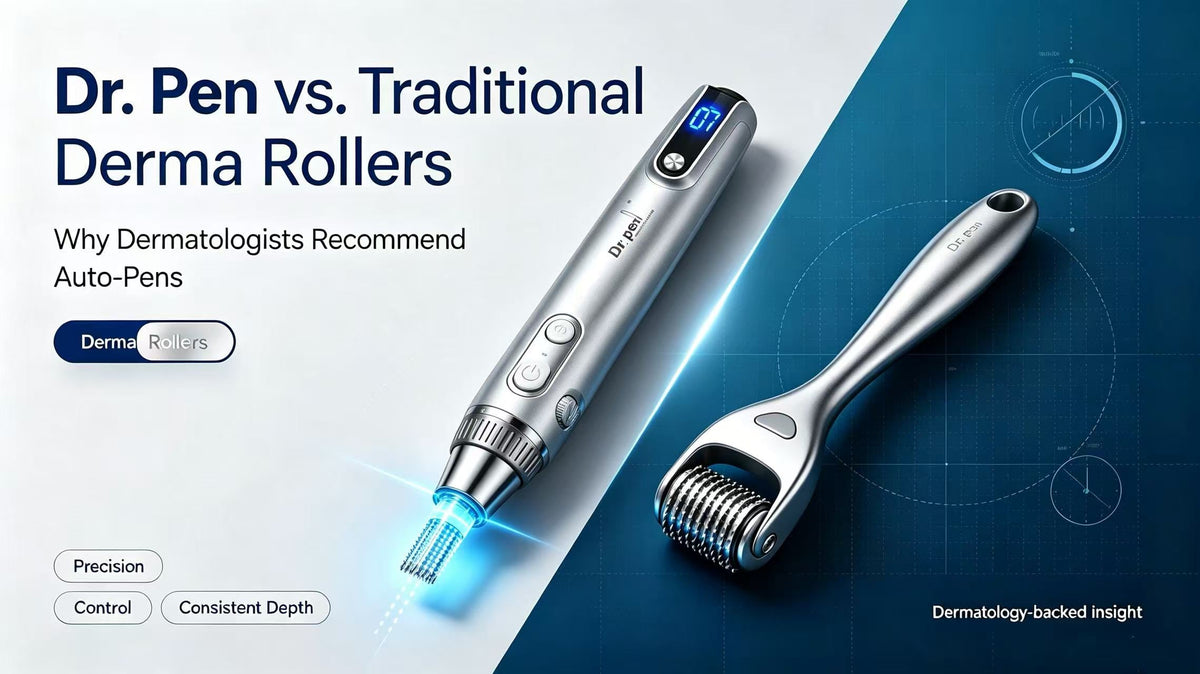
While both tools perform collagen induction therapy by puncturing the skin to trigger natural collagen and elastin production, dermatologists almost universally favor auto-pens (such as Dr. Pen) over traditional derma rollers.
The main reasons dermatologists recommend electric auto-pens lie in skin mechanics, hygiene, precision, and speed.
1. Angle of Entry: Vertical Stamping vs. "Track-Tearing"
The single biggest clinical distinction between the two devices is how the needle enters and exits the tissue.

-
Auto-Pens: Oscillating motors drive needles straight up and down at a clean 90-degree angle. This forms precise, uniform vertical micro-channels without tearing the surrounding surface layer.
-
Derma Rollers: Because the needles are fixed to a rolling wheel, they enter at an angle, rotate through the tissue, and exit at an angle. This rotational movement creates V-shaped micro-tears (often called the "paddle-steamer effect"). This unnecessary epidermal slicing increases pain, extends recovery time, and risks scarring or hyperpigmentation.
2. Dynamic Depth Adjustment
Facial skin varies significantly in thickness across different features.
| Area | Approx. Skin Thickness | Auto-Pen Approach |
|---|---|---|
| Forehead & Periorbital (Eyes) | Very Thin (0.25–0.5 mm) | Adjust speed/dial downward instantly on a single device. |
| Cheeks & Jawline | Moderate (0.5–1.0 mm) | Increase depth dial seamlessly on the fly. |
| Deep Acne Scars / Body | Thick (1.0–2.5 mm) | Set needle extension deeper for local targeted passes. |
3. Hygiene & Infection Risk
Sterilization is a primary safety concern with microneedling tools:
-
Single-Use Sterility: Auto-pens utilize disposable, factory-sealed needle cartridges. Each session begins with a fresh tip, eliminating cross-contamination.
-
Reusability Hazards: Derma rollers are reused over multiple sessions. Disinfecting hundreds of tiny needle bases at home with isopropyl alcohol is notoriously difficult. Trapped dead skin, serum residue, and bacteria can cause breakouts or skin infections.
-
Bent Needles: Over time, roller needles dull or develop microscopic bends (burrs). Dragging burred needles across the face can cause severe micro-abrasions.
4. Contours & High-Precision Target Areas
-
Rollers feature a wide cylindrical barrel that excels on flat, expansive surfaces (like thighs or chest) but struggles on tight facial contours.
-
Auto-pens use a small, round tip that navigates tight angles with ease—including the sides of the nose, above the upper lip, around crow’s feet, and directly over localized acne scars.
5. Contours & High-Precision Target Areas
| Feature | Dr. Pen / Auto-Pen | Traditional Derma Roller |
|---|---|---|
| Puncture Mechanism | Vertical stamping (high-speed motorized oscillation) | Manual rotational entry/exit |
| Epidermal Damage | Minimal (clean, vertical micro-channels) | Moderate to High (V-shaped skin tears) |
| Needle Depth Control | Dial-adjustable on device (0.25 mm to 2.5 mm+) | Fixed per barrel (requires buying multiple rollers) |
| Sanitation | Single-use sterile cartridges | Reusable device; hard to sterilize thoroughly |
| Pain & Downtime | Lower pain, faster recovery (24–48 hrs) | Higher pain, longer downtime (3–5 days) |
| Contour Handling | Excellent (narrow tip reaches nose/lips/eyes) | Poor (wide roller struggles with narrow curves) |
| Upfront Cost | Higher ($80–$250+ device purchase) | Low ($10–$30 per roller) |
6. Conclusions
While derma rollers offer an inexpensive entry point, dermatologists favor electric auto-pens because they maximize collagen production while minimizing epidermal trauma and infection risks. The vertical action protects the skin barrier, and the adjustable settings deliver custom treatments tailored to different facial zones.


